
Using AI in a Small Agency Without Losing the Plot
Radvilas, digital strategist and co-owner of Evolvery, on where AI earns its place in the work and where it quietly wastes your week.
The half day I’m not getting back
A caveat first: what I can offer here is the general, managerial view, how to fit AI into the work, not how to build it.
I sit in a lot of meetings, and I record most of them. Honestly, the recording itself rarely gives me much.
The value comes from pulling three things out of it:
- What other people need to do, so there’s a follow-up and some accountability.
- My own tasks, with a layer on top that I run every time: which of these can I delegate, which can only I do, which can AI do, which can AI do with me, and which can AI not touch at all.
- And the agenda for the next meeting, because if we care about continuity, and we should, the best place to build the next agenda is the meeting that just happened.
I tried to fully automate that part. I thought it would be more efficient than doing it by hand after every meeting.
Wiring it up meant connecting the meeting recorder to AI, to my calendar, and to my email, through a middle platform like n8n, Make, Clay, or Zapier. I can’t code, so it ate half a day, and it was heading for a full one.
And somewhere in that half day, the question that actually matters showed up: was this worth it?
The AI kept reading the same information in ways I’d never have guessed, so I kept stepping in to correct it, until I was just endlessly tuning an automation that was supposed to save me time. It saved me nothing. The half day was gone.
That’s losing the plot.
The boring version works better
Step back and the irony is hard to miss: AI was barely involved to begin with. Its only job was the transcript, turning the audio into a written record. The three things, the actual value, that was me. The healthier way to get the value from the recording is almost dull.
Tools first: to record my meetings, I use Fathom, because it doesn’t over-interpret. Fireflies and Sana are popular too. Bear in mind though, they all hallucinate a word now and then, be it in Lithuanian or English, so test before you trust one.
Then at the end of the day I block a bit of time, open a project I’ve already set up in Claude or GPT whose only job is to read my transcripts and drop things into my calendar, and I do it by hand. I skip the integrations. I skip the middle platform. And precisely because it’s manual, precisely because it is not an “automation,” I get a very good result straight away.
None of this means using less AI. The project still does the work, reading the transcripts, pulling out what matters. What I cut was the automation around it. The half day of wiring was the part that added nothing.
That’s not losing the plot.
Two ways to work with AI
For a long time the thinking was: the people who get replaced will be replaced by people who know how to work with AI. I used to read that as “learn to use AI,” and that’s fine advice. But I think about it differently now.
I’d say there are two directions for working with AI:
- One is working with AI as a colleague.
- The other is building large engineering projects so AI can go and do something on its own.
Projects are one thing. Adding non-human colleagues to your existing processes is a whole other animal. I used to talk to managers about this before I’d actually felt it. Now it’s clearly visible, and I think it’s turning into one of the big changes in how we work. The workforce has changed shape twice before and we’re living through the third now.
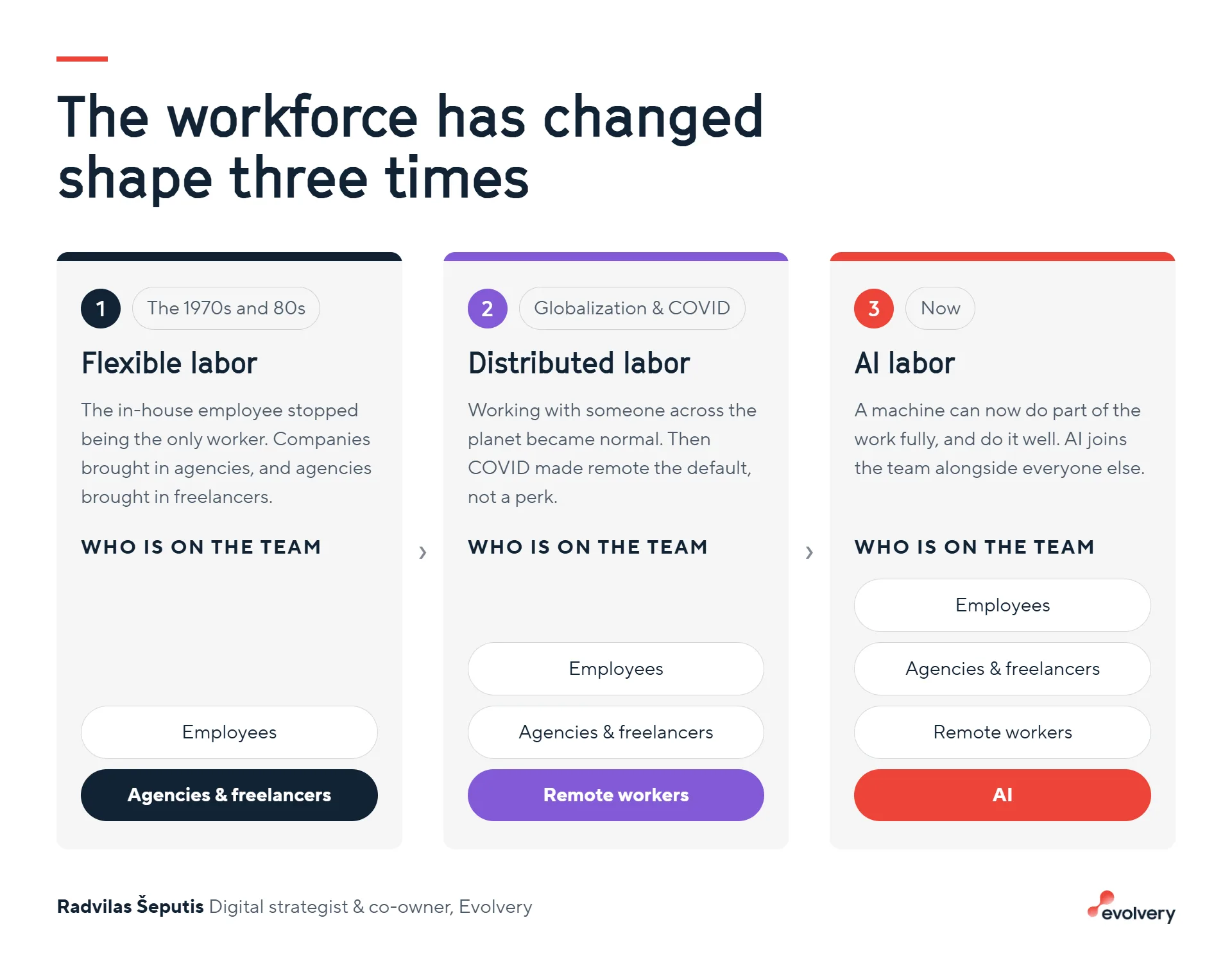
Here are the three workforce shifts as I see them.
1. Flexible labor
In the 70s and 80s, the in-house employee stopped being the only worker. Companies started hiring agencies, agencies started hiring freelancers, because you needed flexible or specialized hands you didn’t need permanently.
2. Distributed labor
Globalization had already been pushing the idea that working with someone on the other side of the planet was fine, the digital nomad building a client’s success spreadsheet row by row from a beach in Bali. Then COVID arrived from the other direction. Nobody could travel, but suddenly everyone worked from home, and remote stopped being a perk and became the default.
That split employers in two: some decided it was completely normal, some decided it would never fit their company. At Evolvery, we side with the first group. Our team is spread across Lithuania, Turkey, and Spain. People come into the office or work from home, and we manage just fine.
3. AI labor
Teams used to be employees. Then employees plus non-employees. Then employees, non-employees, and remote people. Now it’s employees, non-employees, remote people, and AI as part of the team. There’s a part of the work a machine can now do fully, and do well.
AI makes specialists matter more, not less
When people call AI “just a tool,” they’re describing it wrong. It’s a multitool: it can do almost anything. And yet the quality of what comes out is decided by the context you give it, which is to say, by you.
Hand Claude a brief to write a piece of copy. A senior copywriter and a marketing strategist will likely get drastically different results, because the copywriter knows how to write and how to feed context. The strategist might produce something strategically sound that still won’t rank or get picked up, because objectively good writing doesn’t automatically win attention. That gap is human knowledge.
You can turn a screw with a knife, a spoon, or a screwdriver. You get a turned screw either way. But depending on which tool you use, you might wreck the tool, wreck the screw, or do it perfectly, because you matched the tool to the job. Calling AI “just a tool” sells it short.
For us at Evolvery, that’s not just theory.
The daily reporting that used to eat a specialist’s whole morning, collecting and charting numbers, now runs on automation, and that morning goes to the analysis and the conclusions instead. We watch competitors the same way: rather than someone sitting down to a big manual sweep, a move shows up as an alert in Slack, and we catch it and react faster. The pattern is always the same. Let the machine carry the repetitive part, and keep the person on the part that needs judgment.
Context is king
Context is one of the most important things to talk about here, and in a small agency it’s everything. You can automate almost anything now. Before long you could, in theory, run an agency with almost no people, and some will. Whether they can hold onto any authenticity, I don’t know, because what an agency without people has to pull off is close to impossible.
Even a technical, data-heavy agency like ours is often better for having humans in it. The plain reason: we hold context the model doesn’t. It was trained on the internet, and Lithuania is only a tiny slice of the internet. For a market like ours, that means you can’t fully trust what the model thinks it knows.
And context is so much more than facts. As a person you take in a huge amount at once, the words, yes, but also everything around them: the pauses, how fast someone is talking, the way they sit. All of it tells you things a meeting transcript never will. You can read the words alone and get the mood completely wrong.
To feed any of that to AI, you’d have to name each angle yourself and tell it to look, and there’s plenty it will never catch. That’s the human advantage: we read context without choosing a perspective first, just by being present. AI has to be told what to look at before it can look. And the part that matters most: you can sense something in a room without being able to name it, and what you can’t name, you can’t instruct AI to find.
When to use AI automations, and when not
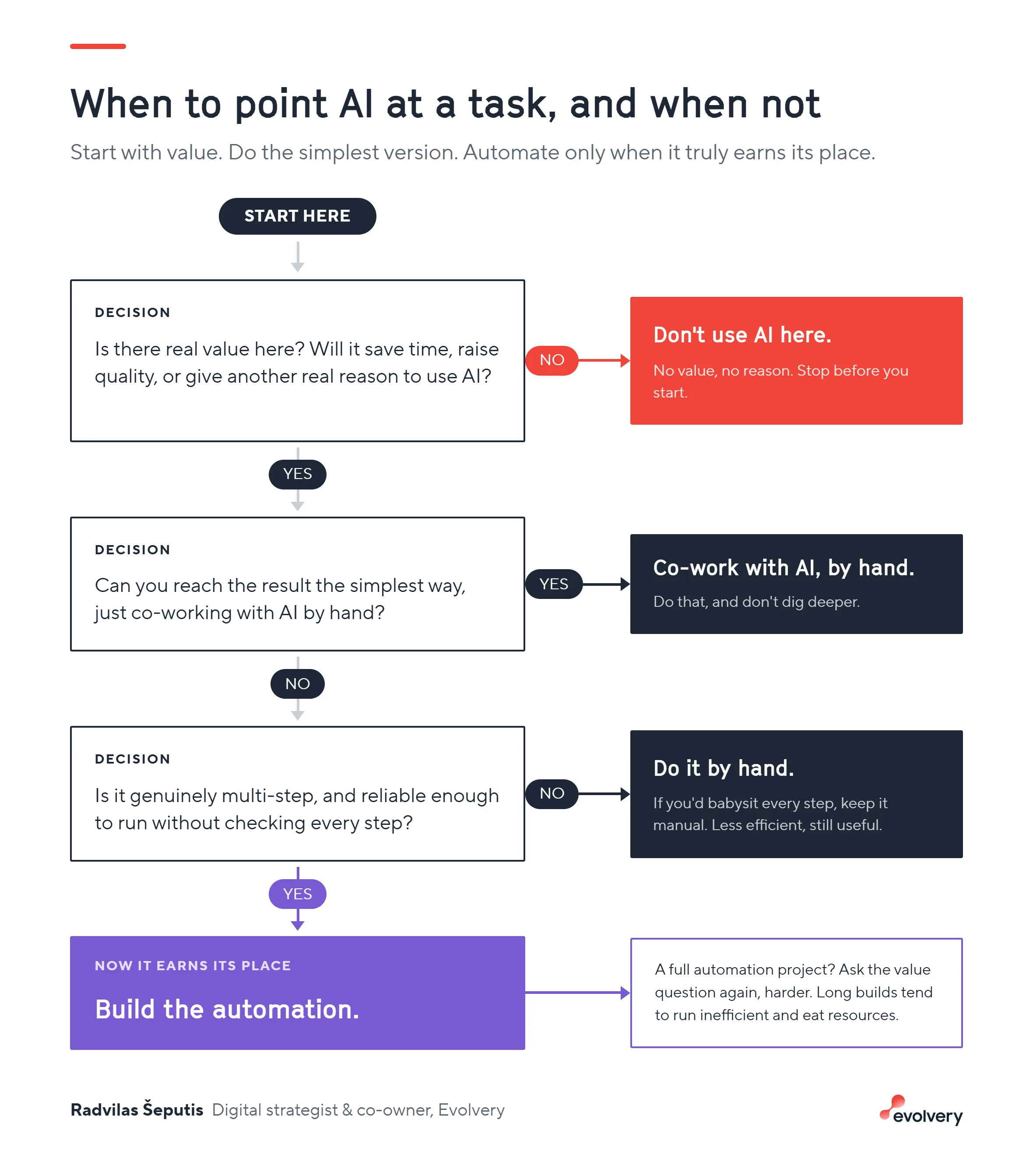
So here’s roughly how I decide whether to point AI at something (and not lose the plot).
- Start with value. Before anything else, ask: will this save time, will it raise quality, is there another real reason to use AI here? If not, stop.
- Then define the absolute MVP, the simplest not-fully-automated way to get the result, without sliding into “Operation: Farewell, Manual Labor”. What I mean is, if you can achieve your goal co-working with AI, great, do that, and don’t dig deeper. If it’s genuinely multi-step, maybe an automation earns its place. But if it’s something you’d have to check at every step to be sure it’s right, do it by hand. Not the most efficient, I know, but useful.
- If you hit the point where you think “this automation project is worth developing,” fine, those need building too. But the value question gets even more important here, because the odds it runs long, runs inefficient, and eats resources are even higher.
- And, of course, the cost. We used to say letting AI do the job costs almost nothing. That’s not the case anymore. Putting AI to work in a role will soon cost about what it costs to employ a person. While that’s not all bad, I do find it a little sad, as it reminds me of a shift in car manufacturing. Let me explain.
The Shelby Cobra problem
The cars I find most beautiful are from the 60s and 70s, less safe, sure, but gorgeous: a Shelby Cobra, a 50s Porsche cabrio, the Mercedes gullwing. Coachbuilding used to be a profession, and mass production killed it. Now a car’s design is boxed in by the machine that has to make the part, and nobody builds one from A to Z by hand anymore. Nothing wrong with that, but expecting original solutions out of that system is nonsense. AI is the same: those come only from the context a person feeds it, and that’s the human value, right there.
I’d be sad to live in a world where people refuse the tool because the human is cheaper to run. And I’d be just as sad in the opposite one, where we hand everything to machines for efficiency and lose the soul, the beauty, the bit that’s a little different. In marketing, an all-machine future is bleak and an all-human one is just slow. The future I want is the middle: people working with AI tools, not refusing it to save money and not handing the place over because machines are faster.
Use AI, use plenty of it. Just don’t lose the plot.
Digital Strategist & Co-owner of Evolvery