What's Behind Successful Conversion Optimization?
An interview with our CRO specialist Ausra about the challenges, tests, and real business changes she sees every day
This article was originally published in Lithuanian.
Picture a bucket. You’re pouring water into it from different channels - Google Ads, SEO, email campaigns, social media. But the bucket has holes. Water leaks out the sides. That’s exactly what happens on most business websites: there’s traffic, but no conversions.
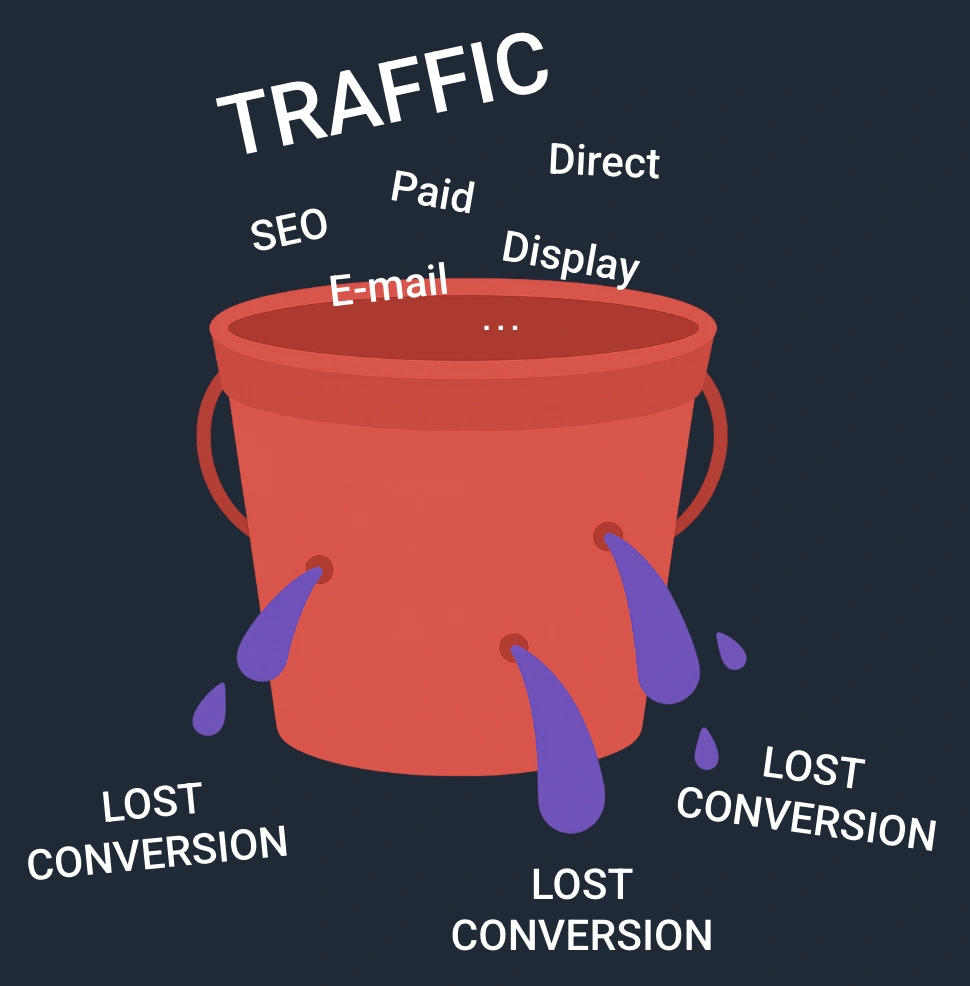
Conversion rate optimization (CRO) helps patch those holes. Instead of spending more to attract new visitors, CRO lets you get more from the traffic you already have. Sometimes bumping a conversion rate from 2% to 2.5% means 25% more revenue from the same traffic. But how does that actually work in practice? What goes on behind the numbers?
We sat down with Ausra Akman, conversion optimization specialist on our team, to talk about this work, what happens behind the scenes, and the real value it brings to businesses.
What exactly is this job?
How would you describe a CRO specialist to someone who’s never heard of it?
I like to explain it through a real shopping experience in a physical store. Imagine walking into a shop where the salesperson follows you around pushing products you don’t care about. You can’t figure out which promotions apply to which items. The signs pointing to the clearance section lead you to a storage room where employees are eating lunch. And the cashier shuts down their register right when you’re ready to pay. A similar shopping experience happens online - except instead of watching it live, we use analytics tools to understand where and why a website visitor stopped short of buying. Once we have that data, we can test changes and, most importantly, measure whether those changes help or hurt the business.
How did you find this field, and why CRO specifically?
I spent a decade managing web projects from concept to full launch and maintenance. We built genuinely beautiful, well-functioning solutions. But over time I noticed a paradox - after a complete design refresh, a website didn’t necessarily earn more money. Sometimes it earned less.
The problem was that we typically built based on sitemap structure, best practices, and design trends. It was especially fashionable to just overhaul an entire website overnight. But very few people actually analyzed how real users behaved on those pages - where they got stuck, what frustrated them, what they needed.
When I started working with CRO, a completely different perspective opened up. It became genuinely fascinating to analyze what works and what doesn’t. And here’s the most interesting part - a solution that works brilliantly for one business can have the opposite effect on another.
What excites me most is that we’re not just testing nicely arranged designs. We’re testing solutions born from specific problems, backed by real data. It’s the difference between “I think this looks better” and “the data shows this variant increased sales by +15%.”
What does a CRO specialist actually do?
What does a typical workday look like?
Days tend to be dynamic - one day might be all data analysis, the next more meetings and coordination. But I usually structure my work like this:
Morning:
- Reviewing ongoing test results - checking trends, stopping finished tests, launching new ones. I summarize the stopped tests: what was the impact, what’s the financial value to the business, and most importantly, what did we learn and how we’ll use it in the next testing steps.
- Daily standup with the team - we discuss priorities, test sequencing, data collection and tracking needs.
Midday:
- User behavior analysis and hypothesis building - I analyze data collected from client websites, build hypotheses, align with clients and the team, gather information for tests, and plan testing strategy.
- Client communication - weekly meetings where I share process updates and results.
Afternoon:
- Strategic work - digging into complex analyses, preparing testing strategies and recommendations, reviewing period results.
- CRO product development - finding ways to improve processes and complete tasks faster while keeping the same quality level (for example, using AI tools).
- Business development - participating in sales processes, preparing and presenting proposals, discussing client needs, KPIs, and opportunities.
- Team growth - training, knowledge sharing, and mentoring.
What tools or methods are your “must-have”?
For me, it’s not about specific tool names. What matters is having data about how users behave on the site. Could be Google Analytics, Hotjar, Clarity, or anything else - the point is getting the information.
The most important thing isn’t which tool you use, but how you look at the problem. Most people think in terms of: “where do I put this button?” or “how will this design look on the page?” The CRO approach is different - you need to visualize the user’s journey and ask: “why does someone stop at this step? What’s blocking them? What do they need to take the next step?”
When I analyze data, I’m not looking for “how to make it prettier.” I’m looking for “what can change user behavior?” If I see people filling out a form halfway and leaving - maybe it’s not a design problem. Maybe they don’t know how long it’ll take? Maybe they’re afraid of getting spammed? Maybe too much information is being asked? The solution might not be a new design, but a progress bar, a trust badge, or simpler questions.
So my must-haves are:
- Data on user behavior (analytics, heatmaps, session recordings).
- The ability to think in terms of user journeys, not page layouts.
- A testing platform to measure whether my hypothesis is right.
Tools change, but this way of thinking stays the same.
Challenges and stereotypes
What’s the biggest challenge in this work?
One of the biggest challenges is working with low-traffic websites. Collecting statistically significant data isn’t impossible, but the threshold you need to cross is pretty high. In those cases, standard approaches don’t work - you really have to think hard about what complex solutions to test and what strategy to choose so that tests create meaningful change and, most importantly, produce statistically reliable results.
Another thing - the fear of losing tests. I actually see enormous value in those, even more than in tests that had no impact at all. A losing test shows us what genuinely doesn’t work, and that helps us avoid wrong decisions down the road. It’s a valuable learning experience.
We also can’t always technically test something on a larger scale. But with long-term clients, we discuss it, assess the situation, and test some solutions together with their help.
Are there any stereotypes about CRO specialists that don’t match reality at all?
I think the most common one is that CRO is a one-time, one-quarter project where you wave a magic wand and double your sales.
In reality, it’s a consistent, long-term process with many small improvements. One test might increase conversion by +5%, another by +3%, yet another might change nothing but teach an important lesson. And it’s exactly that steady optimization over time that produces the biggest results.
I see how our clients, the ones we’ve worked with for years, feel that long-term CRO value. They understand it’s not “fix it and forget it” - it’s continuous learning about their users, their evolving needs, and constant website improvement based on real data.
After a year or two of working together, we’ve built a solid data foundation, learned dozens of lessons about their audience, and can make increasingly informed, strategic decisions.
The value CRO creates for teams and clients
How does CRO work contribute to overall team and company success?
- Grows revenue without additional ad spend - makes better use of existing traffic.
- Reduces risk - tests before making major changes across the entire website.
- Decisions are based on data, not gut feelings.
- Helps prioritize what’s actually worth the time and resources.
- Builds a culture of experimentation instead of “we’ve always done it this way” or “competitors have this feature, so we need it too.”
Can you share an example where a small change produced a really big result?
Through continuous testing, we regularly see winning tests that deliver big results - or losers that could have had a seriously negative impact. But what I find most fascinating is when we learn from tests and apply those lessons to future decisions.
One of the more interesting tests: our hypothesis was to drive more users from the Homepage to the most popular products, which we expected would increase the conversion rate. The test didn’t show increased sales. But here’s where it gets interesting - deeper data analysis revealed that +400% more users went to those products and added them to cart, but… didn’t buy. When we analyzed why, we found the problem - there wasn’t enough stock. You could clearly see that users wanted to go to those products, wanted to buy, but couldn’t because there was simply nothing to buy. We applied this learning in the next testing phase, made sure we only showed products with sufficient stock, and then we had a winner - both traffic to products and sales went up. It’s a perfect example of why it matters not just to check whether a test “won,” but to understand why something happened.
How do you measure success in your work?
We have concrete metrics, of course - conversion growth, financial value to the business, test results. But the best validation for me personally is when I see a client genuinely happy with results, building trust, and handing over more and more questions.
When a client starts inviting us to strategic meetings - not just about tests, but about overall business direction. When they reach out asking for analysis to help answer business questions that aren’t even directly related to conversion optimization. When I see our insights being used not just in marketing, but in product development, pricing strategy, and other decisions.
That means we’ve become more than service providers. We’re trusted business partners whose opinion is valued. And for me personally, that’s the biggest measure of success.
Personal insights
What’s your favorite part of the CRO job?
Honestly, all parts of CRO work are interesting to me, but I enjoy watching the testing process most - seeing what trend is forming, where the results are heading.
It’s especially fun when your expectations are completely wrong. You think: “This solution should definitely be good, it’s obvious!” - and then the opposite happens. What appeals to you as a buyer and seems like it should motivate action might be completely irrelevant or even annoying to another buyer.
I love finding real answers - what actually works and why, not “let’s make a pretty design because that’s what’s trendy right now.”
Every test is like a mini-investigation that reveals something new about user behavior. And that moment when you start seeing clear data - “aha, so that’s why!” - is the best part of CRO work.
What has this work taught you about users or business?
It taught me that what seems logical and obvious to me doesn’t necessarily work for others. Users behave unexpectedly, and the only way to find out what really works is to test it, not guess.
If you could give one piece of advice to someone who wants to become a CRO specialist, what would it be?
I think the most important thing is curiosity and a genuine desire to understand people. It matters to know how to analyze numbers and user behavior, but it matters even more to understand the people themselves - their emotions, fears, and motivations. Pay attention to how users behave, watch for recurring behavior patterns, try to understand why people make certain decisions over others.
It’s worth studying the psychological side too - what truly matters to users, what fears, uncertainties, or doubts stop them from buying. CRO is essentially about answering the questions running through people’s minds as they browse a website. Put simply, it’s about helping them reach their goal by removing obstacles and giving them what they need at the right moment.
Looking ahead
How do you think CRO work will change in the next 5 years?
I don’t think we even need 5 years - changes are happening right now. AI tools help analyze data faster, automate routine tasks, and spot recurring user behavior patterns. But even though tools and capabilities keep growing, human judgment and strategic thinking will remain critically important. AI can tell you “what’s happening,” but strategy, hypothesis building, and understanding user psychology require human thinking. CRO specialists will likely become more valuable not because they analyze data quickly with AI help, but because of their ability to think strategically, create inventive solutions, and understand business context.
What new trends or tools excite you most?
I’m most excited about AI capabilities - it’s like having a colleague or assistant who doesn’t just help generate ideas but also reviews and surfaces what we’ve already learned. When you work with clients over longer periods, it’s physically impossible to remember every lesson learned, every test result, every insight. But here I have an assistant that analyzes from multiple angles - not just data, but accumulated know-how. What worked, what didn’t, what behavior patterns keep repeating. That lets us make better decisions - not starting from zero, but building on what we’ve already learned.
Conversion optimization isn’t a one-time project. It’s consistent learning about your customers, testing what actually works. A single test win might seem small, but a dozen of those improvements over a year create a tangible difference.
Learn more about our conversion rate optimization service.
Founder & CEO of Evolvery